Manifesto
Neurobeat Manifesto
Neurobeat is based on the observation that AI, robotics, and neuroscience will merge within this decade. This convergence is intuitively straightforward given our current trajectory, yet the steps to achieve it are enormous.
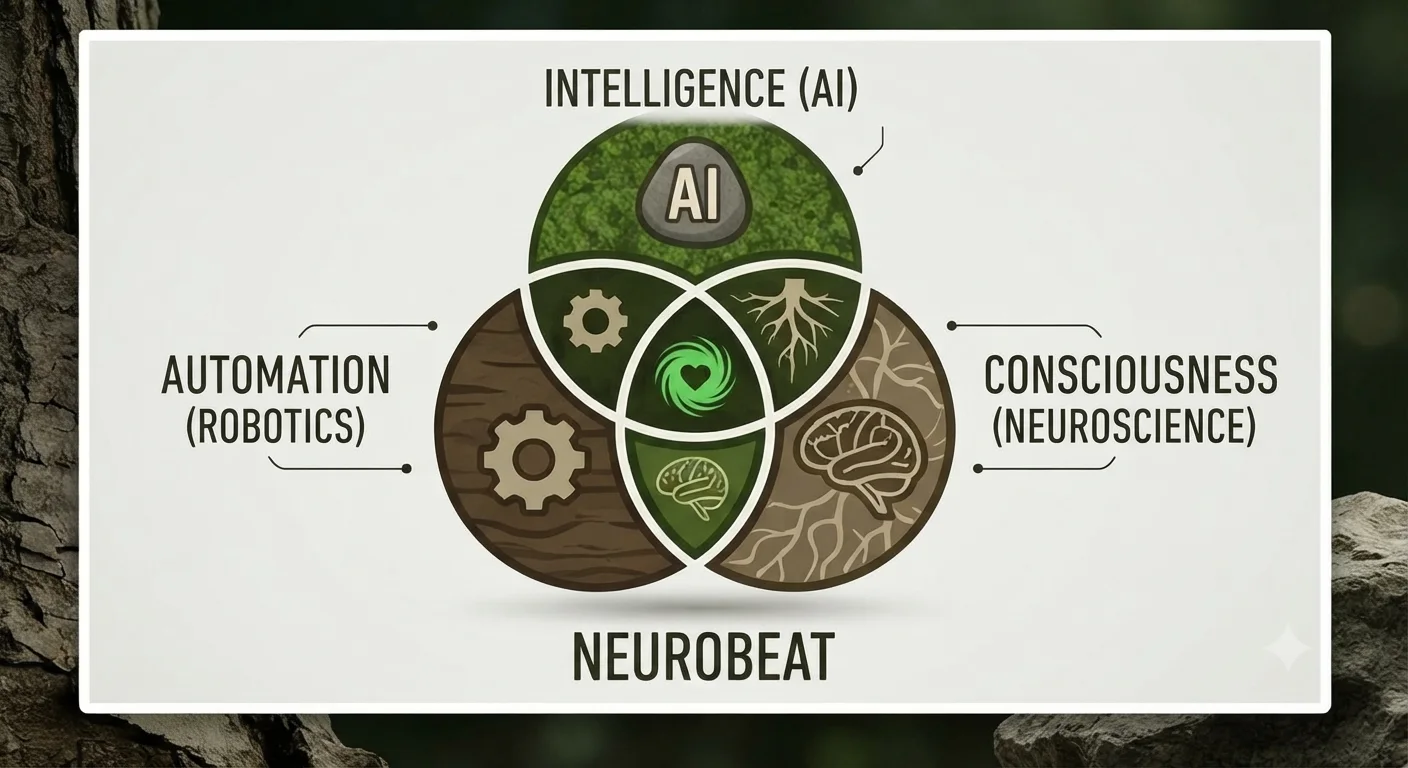
Intelligence, automation, and consciousness — where they meet is Neurobeat.
Tremendous progress has been made on the AI front: the applications are powerful, and the field is filled with dedicated talent. In robotics, companies worldwide are making hardware increasingly open and accessible. However, while the science of neuroscience is proven and robust, the supporting technology and community infrastructure have yet to catch up.
This is not intended as a critique, but an observation: neuroscience—even in the realm of Brain-Computer Interfaces (BCI)—remains a niche field. It is not taught in mainstream curricula, and there is no comparable “maker” community. The field is currently dominated by a highly specialized, ultra-scientific demographic. The technology is similarly constrained; the industry relies heavily on offline processing. There is a lack of real-time processing capabilities, and even scientifically proven methods, such as online Independent Component Analysis (ICA), do not run on accessible, commodity hardware.
It is 2026, yet “real-time” in neuroscience still essentially refers to IIR filters. Furthermore, the cloud technologies that have revolutionized other industries have yet to touch neuroscience. While recent research exists at the intersection of AI and neuroscience, it remains specialized, expensive, and inaccessible to the general public. While the current efforts in the field are commendable, much work is required to democratize this technology. Despite the existence of open-source software, researchers are still forced to rely on expensive MATLAB licenses or proprietary, restrictive models.
Both robotics and AI require neuroscience to deliver real-time, low-latency, and low-jitter performance, alongside complex adaptive algorithms, on-device neural network training, global regulatory compliance, and instantaneous international collaboration. This is what Neurobeat aims to provide: the comprehensive hardware and software ecosystem necessary to fuse AI, robotics, and neuroscience.
Core development applications
AI & Neuroscience
Consciousness Research
Only human-conscious entities should be eligible to vote or receive Universal Basic Income (UBI). “Proof of consciousness” should replace the current CAPTCHA to verify that real humans are navigating the web.
Intent Clarification
Beyond text and voice, streams of neural activity should clarify the intent and state of the user. Information that cannot be expressed via language must be integrated into the prompt to maximize satisfaction for intents that may even be pre-conscious.
Robotics & Neuroscience
Supervisory Chain of Custody
Robotics should operate under a verifiable chain of custody, ensuring operators are human-conscious and in a cognitive state optimized for supervising robot fleets.
Motion Intent
Leveraging neural data to clarify and refine the intent of motion.
Adaptive Bandwidth Management
Maximizing bandwidth by extending the human attention mechanism to information streams. By monitoring attention beyond eye-tracking, we can ensure that information not destined for conscious processing does not congest the network, while critical decision-making data is transmitted with maximum accuracy and the lowest possible latency.
If this is the future you want to build, build it with us.